Wednesday, February 27, 2013

Day 4 with Rose: Cordon Rose Cream Cheesecake


I've graduated from making pound cakes, butter cakes, and fruit cakes.  On my fourth day with Rose, I make a custard cake.

The first custard cake Rose has me make is a cheesecake.  Never having baked a cheesecake before, understandably I am eager to try my hand at it.  That said, I am more than a bit hesitant.  The reason is simple: my mother makes what could possibly be the world's best cream cheesecake.  My niece will support me on this claim.  True, one could argue that we might be a bit biased in our views.  But maybe this will dissuade your skepticism: my niece has traveled to Paris (alongside her auntie) and eaten macarons at Laduree and eclairs at La Maison Angelina, and still -- when asked what her favorite sweet is -- will invariably answer "grandma's cheesecake."  

My mother's cheesecake has a sour cream topping and a graham cracker crust.  The rich creaminess of the topping contrasts beautifully against the crumbly crunch of the crust.  Whenever I'm at my parents' home, I eat cheesecake for breakfast, as a post-lunch snack, and for dessert.  

Rose makes a different kind of cheesecake: in her words, "New York Jewish."  The Cordon Rose Cream Cheesecake is more a custard than a cake, and the recipe calls for it to be baked in a water bath.  I decide to make this cake au naturel, without a crust, as Rose describes it as firm enough to be served without a base.

The results: a dreamy cheesecake -- dense and creamy, with a smooth, silky texture and refreshing notes of lemon and sour cream which get added into the batter.  I frost the cake with a thin layer of white chocolate cream cheese buttercream.  It is the perfect complement: like the cheesecake, it is ivory in color and creamy in texture.  But its taste -- mellower and sweeter -- is an exquisite contrast with the somewhat tartness of the cheesecake.  It's not quite my mother's cheesecake, but it sure comes close.


Cordon Rose Cream Cheesecake
Recipe from The Cake Bible, by Rose Levy Beranbaum

2 (8-ounce) packages cream cheese, softened
1 cup sugar
1 tablespoon cornstarch*
1 cup sugar
1 tablespoon cornstarch, optional
3 large eggs
3 tablespoons lemon juice, freshly squeezed
1/4 teaspoon salt
3 cups sour cream


Preheat the oven to 350 degrees.

In a large mixing bowl, beat the cream cheese and sugar until very smooth (about 3 minutes), preferably with a whisk beater.  Beat in the cornstarch.  Add the eggs, 1 at a time, beating after each addition until smooth and scraping down the sides.  Add the lemon juice, vanilla, and salt and beat until incorporated.  Bean in the sour cream until just blended.

Pour the batter into the prepared pan*.  Set the pan in the larger pan and surround it with 1 inch of very hot water.
*One 8-inch by 2 1/2-inch or higher springform pan, bottom lined with greased parchment or wax paper; outside of the pan wrapped with a double layer of heavy-duty foil to prevent seepage.    

Bake 45 minutes.  Turn off the oven without opening the door and let the cake cool for 1 hour.

Remove to a rack and cool to room temperature (about 1 hour).  Cover with plastic wrap and refrigerate overnight.

To unmold:  Place pan on heated burner and move it around for 15 seconds.  Wrap sides of pan with a hot, damp towel.

Run a thin metal spatula around the sides of the cake and release the sides of the springform pan.  Place a plastic-wrapped plate on top and invert.  Remove the bottom of the pan and the the parchment.  Reinvert onto a serving plate.  Refrigerate until shortly before serving. 


White Chocolate Cream Cheese Buttercream
Recipe adapted from The Cake Bible, by Rose Levy Beranbaum

4 ounces white chocolate
6 ounces cream cheese (softened)
6 tablespoons unsalted butter (softened)
2 1/4 teaspoons lemon juice, freshly squeezed

Break the chocolate into squares.  Melt in microwave oven, stirring every 15 seconds.  Remove from microwave before fully melted and stir, using residual heat to complete the melting.  Allow to cool.

In a mixing bowl beat the cream cheese until smooth and creamy.  Gradually beat in the cooled chocolate until smoothly incorporated.  Beat in the butter and lemon juice.

Thursday, February 21, 2013

Birthday Sweets (Bakery Crawl NYC)


our guide for Bakery  Crawl NYC
To celebrate my birthday, Greg and I went on a sweet adventure: a bakery crawl.  We visited five of the top bakeries in NYC, sampling sweets from each.

Stop #1 was Bien Cuit, an artisanal bakery which features authentic French staples like baguettes and croissants alongside dainty tarts.  The name translates to "well done," a term that the French often use to describe the darkest of their crunchy loaves.  It's an apt name for this bakery, where the breads and pastries -- baked to the point of well-done-ness -- have a deep brown sheen to them.  


The tantalizing aroma of fresh-baked treats greeted us as soon as we stepped in, which is no wonder since all of the baking occurs on-site.  Greg and I shared a double-baked almond croissant, which was nothing short of perfection.  The deep brown edges of the croissant lent an almost-burnt quality to its taste, which was perfectly balanced by the generous sprinkle of powdered sugar that coated the entire surface.   The layers inside were rich and buttery and filled with almond slivers and a velvety almond creme.  The shell of the croissant cracked into shards when I bit into it, and I took care to scoop up each piece that fell onto my plate.


Our next step was Crespella, an Italian creperie (the name translates to "stuffed pancake" in Italian).  The creperie is a teeny-tiny establishment with a surprisingly large menu (the menu takes up an entire back wall) boasting upwards of a few dozen varieties of crepes, both sweet and savory.  We were really tempted to get a sweet crepe (we could have chosen from amongst nutella, marmalade, cannoli, and peanut butter, to name a few!) but instead decided on two savory ones: for me, the zucchini, onions, pepper, and balsamico crepe; and for Greg, the scrambled egg, provolone, and pancetta crepe.  The savory crepes at Crespella are made with gluten-free chickpea flour, something we were both intrigued by; we also were beginning to crave some protein to stave off our hunger pangs.  

My dish was artfully served: the vegetables were neatly folded into the crepe, and topping it were a few chopped pieces and a drizzle of balsamico.  I admired the crepe long enough to snap a photo and then devoured it.  The crepe itself was thicker than I expected but cooked perfectly, and the hearty meal was just what we needed to get to our next destination: Levain Bakery.

Levain Bakery is perhaps most famous for its cookies.  This wee bit of a bakery churns out chunky, hocky-puck-size chocolate walnut, oatmeal raisin, and dark chocolate, chocolate cookies.  But what drew us there was the sourdough roll.  On the outside, the roll appears modest: it is lightly freckled with a crisp crust.  But looks can be deceiving: bite into the roll and you'll discover, tucked into its nooks, melted Valrhona dark chocolate.  Or so we learned on Unique Sweets.  By the time Greg and I arrived at Levain, around noon, the rolls were all sold out.  We were terribly disappointed.  


To appease ourselves, we dug into their sour cream coffee cake.  Unlike a typical sour cream cake with a streusel topping, Levain's version has a pocket of cinnamon-brown sugar swirl, in the shape of a smile, adorning the bottom edge of the cake.  This cake was generously sliced and moist and delicious.  It was bitterly cold out, so Greg and I snagged two seats along the short counter to enjoy the cake.  There was a constant buzz of activity in the bakery, with customers traipsing in, eager smiles on their faces; staff on hand taking orders; and bakers concentrated on their trade, removing trays out of the oven.


There was a constant line out the door, so to make room for others, we soon left to make our way to our fourth stop of the day: Petrossian.  The Petrossian Boutique & Cafe is housed on the ground floor of an ornate terra-cotta clad building in the French Renaissance style.  Inside, the boutique is cheery, with an assortment of jams, breads, pastries, and mini cookies lining the bakery counter.  On the wall directly opposite are Petrossian's signature caviar, smoked fish, and other fine foods (Petrossian also runs a restaurant).  Up the steps towards the back of the store is a small but comfortable seating area where breakfast, light lunches, and tea are served.  


Greg and I decided we would have tea and a tart and nestled into a table for two.  We ordered the blueberry tart.  Sweet blueberries and a few giant blackberries were packed inside a golden tart shell.  Sandwiched in-between was a thin layer of marzipan filling, gooey and slightly nutty.  Candied orange shavings added a bright, citrus accent.  Each bite was a new revelation.  The depth of flavors was pretty astounding.  But it was the shell -- buttery, flaky, and tender -- that stole the show.


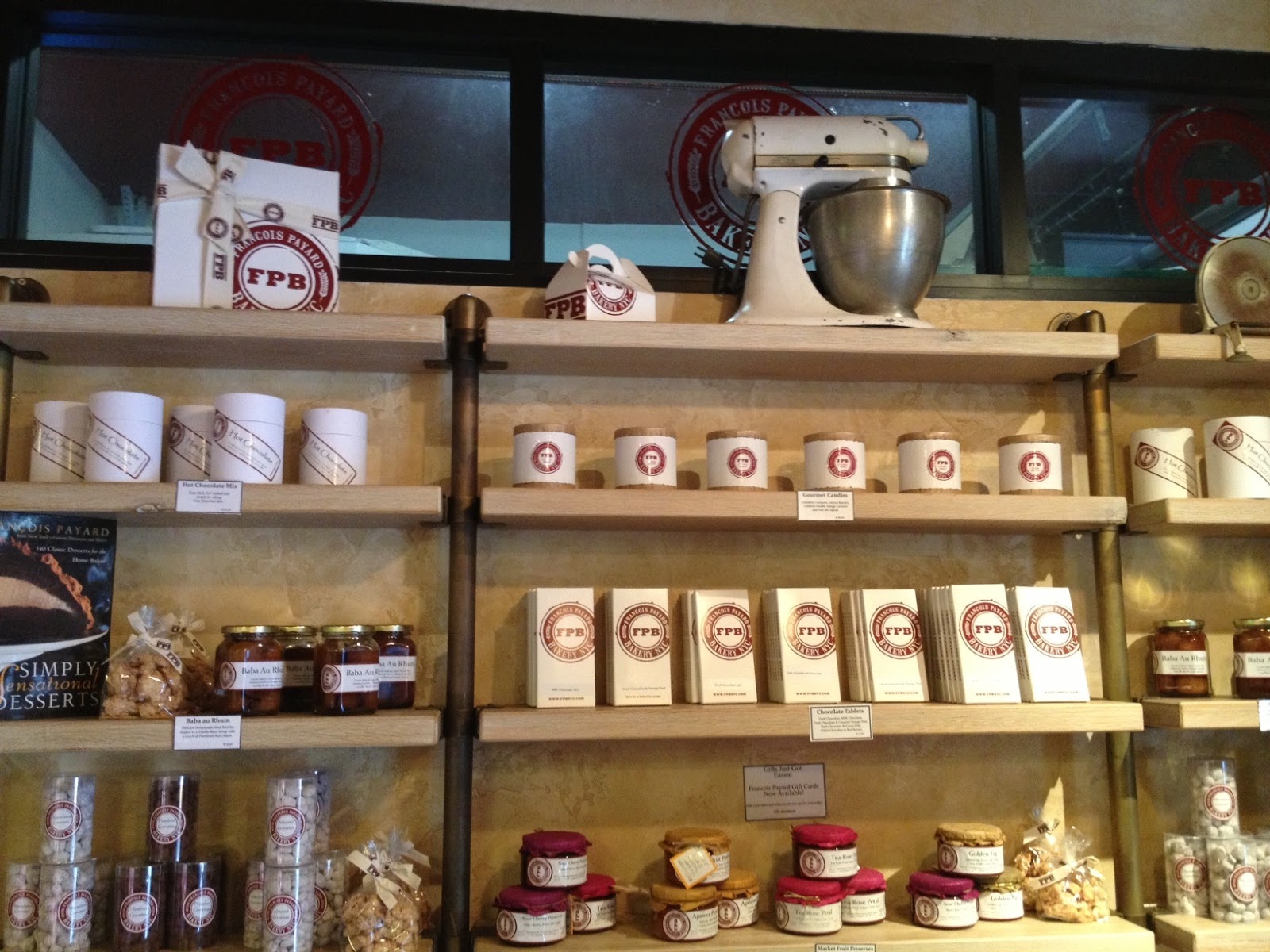
Warmed from the tea, we headed to Francois Payard.  This, we decided, would be our last stop of the day.  It was nearing late afternoon, and we still had to get ready (and leave room in our bellies!) for our celebratory dinner.  Greg had made dinner reservations for us at a restaurant in SoHo.  The legendary pastry chef's bakery has a charming interior, with a chalkboard menu adorning one wall, and on the other wall, tall shelves displaying packaged macarons, jams, and cookies, and even an antique stand mixer.  


We shared Le Gateau Roule, or the sponge cake roll.  Alternating layers of chocolate cake, raspberry preserve, and smooth chocolate cream were rolled to form a decadently moist roule.  The outermost layer was a dark chocolate ganache, imparting a silky sheen and intensely rich flavor to the roll.  Crunchy chocolate meringue rolls dotted the top of the roll.  It was exquisite.  We were sad to leave.


We ate a delicious dinner and decided to skip dessert, only to head home and eat the roasted pear, caramel, and hazelnut tart that we had taken to-go earlier in the day from Bien Cuit.  As soon as I blew out the birthday candle, we reached for a fork.  I can't think of a dreamier combination of textures and flavors than this tart.  An intensely sweet, smooth caramel filling sat in a pate sucree crust that was baked to perfection, tender yet crisp.  Slivers of roasted pear, nestled in the tart, retained their succulence, and the toasted hazelnuts added some crunch.  It was sublime.  Greg and I were fighting to lick the caramel off the fork.  And that is how we ended this sweet day.  Really, there is no better way to celebrate a birthday than with a sweet dessert and even sweeter company.


Monday, February 18, 2013

Bakery Crawl NYC

the Paris-Brest (pate a choux, praline cream, and carmelized hazelnuts) at Bosie Tea Parlor
In celebration of my birthday, today Greg is taking us on a bakery crawl.  We'll be visiting some of the top bakeries in NYC.  I first tossed out the idea two weeks ago, and we've since been putting together a short list of bake shops to visit.  

A few of these have been featured on Unique Sweets, the Cooking Channel show that celebrates original concoctions of the sweet variety.  The show takes viewers across the country to showcase sweets of every shape, size, and taste, and introduces the bakers behind these masterful creations.  Still other bakeries on our list Greg has found through internet sleuthing.

Sadly, we can't visit them all in one day (that's me as responsible adult talking; the child in me wants to stop by each and every one).  As a consolation, Greg has already promised a Bakery Crawl Part II will follow soon.  For now, we'll have to make do with six.  On today's itinerary are: in Brooklyn -- Bien Cuit and Crespella; and in Manhattan -- Francois PayardGrandaisy Bakery, Levain Bakery, and Petrossian.  Their specialties run the gamut from French macarons to buttery scones to artisanal breads.

I have a feeling we'll be loosening our belts over the course of the day as we sample mouth-watering sweet after sweet.  Photos and stories to be posted in the coming days.  In the meantime, let the munching begin!


Add caption


Saturday, February 16, 2013

On family and shared meals


To me, there is no better way to spend time with loved ones than through a shared meal: to put aside distractions, gather around a table, and settle down to eat.  Because when having a meal together, you share not only the food but stories, ideas, and laughter, too.  It's a ritual that always leaves me feeling satiated, belly full and heart content.

Greg and I just returned from spending five days with his dad and step-mom in sunny Orlando.  As it was my first time there, we made the obligatory first-time visit to Disney World, and spent a fun-packed day at Animal Kingdom.  The next day we drove to a wildlife preserve where we saw creatures (mostly winged) of all colors and sizes: lanky ostriches, great blue herons, long-legged limpkins, a pair of stately sandhill cranes, a few menacing (though in our case sleeping) alligators, and even a bald eagle soaring overhead.

Aside from these outdoor adventures, some of the best moments we spent with his dad and step-mom were over shared meals.  The fun part: we all took turns cooking for each other.  His dad, a master at the grill, cooked up burgers and steaks.  But these weren't just any burgers and steaks: they came from cows that he himself raised!  The meat was succulent and flavorful and -- in meeting the grower himself -- it was the closest I've gotten to farm-to-table cuisine!  

I discovered my new favorite fish when Greg's step-mom prepared some perch and walleye.  She and Greg's dad go fishing on a lake near their home in Ohio on a near-weekly basis.  They brought some of their recent catch to Orlando with them.  The fish was lightly battered and deep-fried and served alongside some rice and lemon wedges.  It reminded me how sometimes the simplest dishes are the most delicious.

For our part, Greg and I prepared an Indian meal: chicken cooked in a yogurt-almond sauce. I found the recipe in Madhur Jaffrey's enchanting memoir "Climbing the Mango Trees," where she describes the dish as one of her favorites when entertaining.  There are many flavors that meld together so wonderfully in this dish: the slightly charred taste of the quick-browned onions; the whisked yogurt made tangy with the additions of garam masala, corinder, and cayenne; the sweet-and-savory combination of the blended paste of ginger and garlic which get stirred in with the cinnamon sticks and golden raisins.  (As Greg's dad is on a nut-free diet, we omitted the almonds, but the sauce was thick nonetheless.)  The heady smell of the spices and the complex flavors of the sauce made for an intoxicating meal.  


Chicken Cooked in a Yogurt-Almond Sauce (Murgh Korma)
Recipe adapted from Climbing the Mango Trees, by Madhur Jaffrey

1 2.5inch piece of fresh ginger, peeled and chopped
4-5 coves garlic, peeled and chopped
3 tablespoons blanched, slivered almonds
1 1/2 cups Greek yogurt
1 1/2 teaspoons garam masala
1 tablespoon ground coriander
1/2-1 teaspoon cayenne pepper, to taste
1 1/2 teaspoon salt
2 tablespoons olive oil
2 medium onions, peeled, cut in half lengthwise and thinly sliced into fine half-rings
2 2-inch cinnamon sticks
8 whole cardamom pods
2 bay leaves
3 1/4-pounds whole chicken, cut into 8 pieces, skinned
2 tablespoons golden raisins

Put the ginger, garlic and 1/4 cup water into a blender or food processor.  Blend until you have a smooth paste. Add the almonds and another 2 tablespoons water.  Blend again until you have a smooth paste.

Put the yogurt in a bowl and whisk the garam masala, coriander, cayenne, and salt into it.  Stir well to mix.

Put the oil into a large, preferably nonstick pan and set it over medium heat.  When it is hot, put in the sliced onions.  Stir and fry for 10-12 minutes, until the onions are reddish brown.  Remove the sliced onions with a slotted spoon, leaving as much oil behind as possible.  Spread the onion slices over a paper towel-lined plate.

Put the cinnamon, cardamom, and bay leaves into the same pan over medium heat.  Stir once or twice.  A minute later, put in the chicken pieces, only as many as the pan can hold in a single layer.  Brown the chicken pieces lightly on both sides, removing them to a bowl.  Do all the chicken pieces this way.  

Add the golden raisins to the pan.  Stir a few times, then add in the paste from the blender.  Stir and fry for 2 minutes.  Now put in the contents of the bowl with the chicken, the contents of the yogurt bowl, and the fried onions.  Stir to mix and bring to a simmer, still on medium heat.  Cover, turn the heat to low, and cook gently for 25-30 minutes, stirring gently every now and then, until the chicken pieces are tender.  Serve immediately.

Monday, February 11, 2013

Day 3 with Rose: Cordon Rose Banana Cake


Holiday (with Greg's family), a badly bruised hand (from said holiday), work (business trip to London), and a snow storm (resulting in canceled flights back to NY) have kept me away from my beloved kitchen these past two weeks.

I'm back now, and all I want to do is bake! 

On my third day with Rose, I make a fruit cake.  Lest the words "fruit cake" conjure unpleasant images of leaden cake stuffed with unnaturally colored, jellied fruit pieces, rest assured that this is a remarkably different kind of fruit cake.  It is the Cordon Rose Banana Cake.  It's one of Rose's personal favorites (which to me says a lot), and it's also become one of my new favorites.  (I have a strong feeling that I'll be adding very quickly to this list in the coming weeks.)

The Cordon Rose Banana Cake is a variation of the basic butter cake, which I've previously written at length about.  Pureed banana supplies much of the liquid for this cake.  Like the other of Rose's butter cakes, it is exceedingly moist.  The flavors are also exquisite: the slight tang of the sour cream plays off the sweetness of the bananas, and a hint of lemon further brightens up the flavors.  I can't think of a better frosting to top the cake than a sour cream ganache.  The result: a dessert that's equal parts simple and sublime.


Cordon Rose Banana Cake


Recipe from The Cake Bible, by Rose Levy Beranbaum

2 large ripe bananas
2 tablespoons sour cream
2 large eggs
2 teaspoons grated lemon zest
1 1/2 teaspoons vanilla
2 cups sifted cake flour
3/4 cup + 2 tablespoons sugar 
1 teaspoon baking soda
3/4 teaspoon baking powder
1/2 teaspoon salt
10 tablespoons unsalted butter

Preheat the oven to 350 degrees.

In a food processor process the banana and sour cream until smooth.  Add the eggs, lemon zest, and vanilla and process briefly just to blend.

In a large mixing bowl combine the dry ingredients and mix on low speed for 30 seconds to blend. Add the butter and 1/2 the banana mixture. Mix on low speed until the dry ingredients are moistened. Increase to medium speed and beat for 1 1/2 minutes to aerate and strengthen the cake's structure. Scrape down the sides. Gradually add the remaining banana mixture in 2 batches, beating for 20 seconds after each addition to incorporate the ingredients and develop the structure. Scrape down the sides.

Scrape the batter into prepared pan* and smooth the surface with a spatula. Bake 30 to 40 minutes or until a wire cake tester inserted in the center comes out clean and the cake spring back when pressed lightly in the center.


*One 9-inch by 2-inch cake pan, greased, bottom lined with parchment or wax paper, and then greased again and floured. 

Let the cake cool in the pan on a rack for 10 minutes. Allow the cake to cool completely before wrapping airtight.


Saturday, January 26, 2013

Stew for a cold winter's day

white bean stew topped with garlicky broccoli rabe
There's nothing quite like stew to warm you up on a cold, winter's day.  Temperatures have dipped into the twenties here in NY, and all I want to do is curl up on the sofa with a bowl of piping hot stew and a good read.  
It seems I can't get enough of cooking & baking even when I'm not in the kitchen: my current read is a food memoir, by Gesine Bullock-Prado (if that name rings a bell, she's the younger sister of actress Sandra Bullock).  In the wake of her mother's death, Gesine turns to baking to mourn and heal.  Baking conjures up warm childhood memories of her mother's wondrous baked creations and other sweet indulgences, and it infuses happiness into her otherwise miserable days toiling in Hollywood.  Not soon after, she finds herself in Vermont ... with her very own bakery!  The book is called Confections of a Closet Master Baker.  It's an inspiring story, and a tasty morsel of a book, too, with over a dozen scrumptious recipes that scream out to be tried.  There is one sentence in the book that I especially love: In recounting how she got to be a master baker, Gesine writes, "I baked because it made me content and fulfilled and it brought happiness to others."  That's why I bake, too.

But back to something savory, the stew.  Tonight I'm making one of my favorites, a white bean stew with rosemary.  Offer me legumes any time of day, and I will not refuse; I simply love them.  This stew is incredibly simple, requiring just a few ingredients.  The flavors of rosemary and garlic, while subtle, infuse every spoonful.  

The recipe calls for dried white beans.  They're most commonly packaged in plastic bags, but I always look for ones sold in sealed containers (they're sold in bulk bins at Whole Foods, for example), because they last longer when stored that way.  The beans should be soaked for a minimum of eight hours.  Recipes usually say "soak overnight," but if you're planning on cooking them for dinner, the beans can be soaked first thing in the morning.  Soaking allows for shorter cooking times, preserves most nutrients, and allows the beans to cook evenly.  For a smoother, more velvety texture, once simmered a portion of the beans can be pureed in a blender.   I like topping my stew with some garlicky greens and served alongside some crusty bread.  The recipe, as written, is vegetarian, although it can be modified by adding some pancetta or thick-cut bacon.  

White Beans with Rosemary Stew
Adapted from Madhur Jaffrey, "World Vegetarian."  Serves 4


1 1/2 cups dried white beans, picked over and rinsed
1/4 cup olive oil
1 teaspoon finely chopped fresh rosemary
1 medium onion, peeled and chopped
2 garlic cloves, peeled and finely chopped
1 medium tomato, finely chopped
1 bay leaf
1 1/4 teaspoons salt
freshly ground pepper

Soak the beans for a minimum of eight hours.  Drain, discarding the soaking liquid.

Put the oil in a wide, medium pot and set over medium-high heat.  When hot, put in the rosemary, onion, and garlic.  Stir and fry for 3 to 4 minutes, or until the onion just starts to brown.  Add the tomatoes and bay leaf and stir for a minute, then add the drained beans, 3 1/2 cups of water, salt, and pepper to taste.

Bring to a boil.  Cover, turn the heat down to low, and simmer gently for 1 1/2 hours, or until the beans are quite tender.

For a pureed, smoother texture, place about 1/3 of the beans, along with some of the liquid, to a blender.  Blend until thick and smooth.  Return blended soup to pot and stir.

Serve immediately.

Monday, January 21, 2013

Day 2 with Rose: Eggs--whites or yolks?


My second day with Rose is a lesson on eggs.  I have graduated from making pound cakes to making butter cakes.  I am feeling rather proud.  I am also feeling more relaxed, given how swimmingly I did on Day One.  No bundle of nerves, no frantic running around the kitchen.  This day should go smoothly.

The ingredients for making butter cake fall into two main categories: those that form and strengthen the cake structure, and those that weaken it.  Flour and eggs fall into the first category; both contain proteins that, when baked, coagulate (i.e., change into a thickened mass) to form the supporting structure of the cake.  Fat, sugar, and leavening fall into the second category of ingredients; they tenderize the cake structure by weakening it.  Liquids fall somewhere in between the two: liquids combine with the flour to form gluten, which is necessary to add to the structure of the cake.  But too much liquid and the cake will be heavy, and too little liquid and the cake will collapse.  Just the right amount of liquid will create a moist cake with enough structural support.

For my lesson on eggs, I am making two kinds of butter cakes: one with egg yolks instead of whole eggs (Golden Butter Cream Cake), and the other with egg whites only (White Velvet Butter Cake).  Using egg yolks instead of whole eggs adds flavor and color as well as a fineness of crumb to the cake.  Based on Rose's explanations, I should expect the Golden Butter Cream Cake to be more golden in color and richer in flavor relative to the White Velvet Butter Cake; the crust should also brown more because yolk is higher in protein.  On the other hand, I should expect the White Velvet Butter Cake to be slightly softer because yolk becomes firmer after coagulating than do egg whites.


Golden Butter Cream Cake batter
 
Golden Butter Cream Cake, right out of the oven.  True to its name, it is golden in color.  As expected, the crust has browned and forms a nice firm outer layer.

Golden Butter Cream Cake adorned with Royal Honey Buttercream frosting.  Exquisite!
I make the Golden Butter Cream Cake first.  While the cake is baking, I set to work on the frosting, a Royal Honey Buttercream.  This is another one of Rose's concoctions.  It is essentially more egg yolks and butter with a squirt of honey thrown into the mix.  Twenty-five minutes later, I take out the cake, which is a golden yellow.  I can't wait to eat it; in fact, I don't.  Before it's completely cooled, and before I've even finished making the frosting, I bite into it.  

Wow! is the first word that escapes my mouth.  The cake is light and airy on the inside.  And the crumb ... the crumb!  The fine crumb of the cake is what gets me really excited.  The cake is velvety and nearly melts in my mouth.  It is like no cake I've ever baked before. 

I tear myself away from the cake to finish making the frosting.  On its own, I find the Royal Honey Buttercream too buttery for my liking, but I am drawn to its dreamy aroma.  Once I spread it on the cake, I discover that its creaminess is a nice complement to the fine texture of the cake.

(Tip: If you aren't planning on using the left-over egg whites right away, they can be stored covered in the fridge for a few days.)
White Velvet Butter Cake frosted with Maple Buttercream.  The buttercream has a softer hue relative to the Royal Honey Buttercream.  The cake itself is white.

I make the White Velvet Butter Cake next.  If I thought I had found the ultimate cake in the Golden Butter Cream Cake, I realize I may have been wrong.  The White Velvet Butter Cake is moist and soft and, best of all, springy.  Sweet, buttery flavors bounce off of the cake onto my taste buds.  

I've made the White Velvet Butter Cake into a two-layered cake.  I had intended to adorn the cake with Raspberry Buttercream.  I hadn't read through the entire recipe for the frosting, though, which calls for the frozen raspberries to be thawed in a strainer suspended over a bowl over the course of several hours.  That's more hours than I have so late in the evening.  (Important lesson learned: Always read through the entire recipe (frosting included) before beginning to bake.)  So I decide on Maple Buttercream.  This is a variation on Rose's classic buttercream frosting; maple syrup and maple extract replace the corn syrup.  I don't have any maple extract on hand so I make do without.  I know it is only my second day with Rose, but I feel that this slight deviation can't be helped.  In fact, I think it comes out fine; I can't imagine how a more concentrated flavor can improve the already richness of the frosting.  

Once the frosting sets on the cake, it forms a nice "crust."  It is time to eat!  My fork hits the rich maple outer layer of the cake.  It sinks into velvety cake before passing through another thick layer of maple frosting on its way to the second layer of velvet.  The experience is pure delicate goodness.

Can it get better than this?  Next up: fruit cake.  More on that next!


Golden Butter Cream Cake
Recipe from The Cake Bible, by Rose Levy Beranbaum

Room temperature
3 large egg yolks
1/2 cup heavy cream
3/4 teaspoon vanilla
1 1/2 cups sifted cake flour
3/4 cup sugar
1 1/4 teaspoons baking powder
1/4 teaspoon salt
10.5 tablespoons unsalted butter (must be softened)

Preheat the oven to 350 degrees.
 
In a medium bowl lightly combine the yolks, 2 tablespoons cream, and vanilla.

In a large mixing bowl combine the dry ingredients and mix on low speed for 30 seconds to blend.  Add the butter and remaining 6 tablespoons cream.  Mix on low speed until the dry ingredients are moistened.  Increase to medium speed and beat for 1 1/2 minutes to aerate and develop the cake's structure.

Scrape down the sides.  Gradually add the egg mixture in 3 batches, beating for 20 seconds after each addition to incorporate the ingredients.  Scrape down the sides.

Scrape the batter into the prepared pan* and smooth the surface with a spatula.  Bake 25 to 35 minutes or until a wooden toothpick inserted in the center comes out clean. 
*Grease a 9-inch by 1 1/2-inch cake pan, line the bottom with parchment or wax paper, and then grease again and flour.

Let the cake cool in the pan on a rack for 10 minutes and invert it onto a greased wire rack.  For an attractive top crust, reinvert so that the top is up and cool completely before wrapping airtight.

Serve at room temperature.


White Velvet Butter Cake
Recipe from The Cake Bible, by Rose Levy Beranbaum.  Makes two cakes.

Room temperature
4 1/2 large egg whites
1 cup milk
2 1/4 teaspoons vanilla
3 cups sifted cake flour
1 1/2 cups sugar
1 tablespoon + 1 teaspoon baking powder
3/4 teaspoon salt
12 tablespoons unsalted butter (must be softened)

Preheat the oven to 350 degrees.

In a medium bowl lightly combine the egg whites, 1/4 cup milk, and vanilla.
In a large mixing bowl combine the dry ingredients and mix on low speed for 30 seconds to blend.  Add the butter and remaining 3/4 cup milk.  Mix on low speed until the dry ingredients are moistened.  Increase to medium speed and beat for 1 1/2 minutes to aerate and develop the cake's structure.

Scrape down the sides.  Gradually add the egg mixture in 3 batches, beating for 20 seconds after each addition to incorporate the ingredients.  Scrape down the sides.

Scrape the batter into the prepared pans* and smooth the surface with a spatula.  Bake 25 to 35 minutes or until a wooden toothpick inserted in the center comes out clean.  
*Grease two 9-inch by 1 1/2-inch cake pans, line the bottoms with parchment or wax paper, and then grease again and flour.

Let the cakes cool in the pan on a rack for 10 minutes and invert it onto a greased wire rack.  If baked in a loaf pan, to keep the bottom from splitting, reinvert so that the top is up and cool completely before wrapping airtight.

Serve at room temperature.